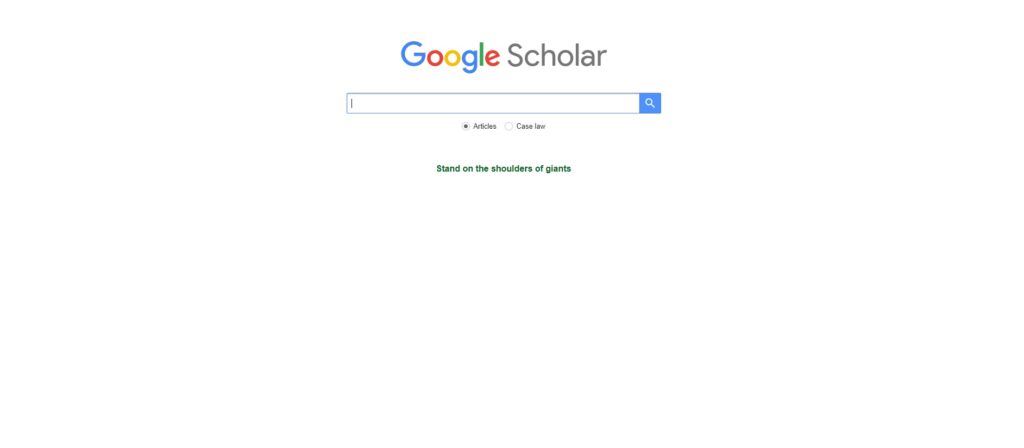
Google Scholar is a search engine that can be used to find scholarly articles, academic papers, books, and other sources of information. It is designed specifically for researchers, students, and other professionals who need to find reliable and comprehensive information on a particular topic.
Google Scholar is different from the regular Google search engine because it only searches academic resources. This includes peer-reviewed journal articles, book chapters, conference proceedings, dissertations, and more. The search results are sorted by relevance, with the most highly cited and most relevant sources appearing first.
Using Google Scholar to find factual information is quite simple. Here are the steps you can follow:
Step 1: Go to Google Scholar
The first step is to go to the Google Scholar website (scholar.google.com). You can also access Google Scholar from the regular Google homepage by clicking on “Scholar” in the top left corner.
Step 2: Enter Your Search Query
Once you are on the Google Scholar homepage, enter your search query into the search box. You can enter keywords, phrases, or questions related to your topic. You can also use advanced search options, such as searching for a specific author or publication.
Step 3: Review the Search Results
After you have entered your search query, Google Scholar will show you a list of search results. The results will be sorted by relevance, with the most relevant sources appearing at the top of the list. Each result will include the title of the article or source, the author’s name, and a short summary of the content.
Step 4: Refine Your Search Criteria
If you are not finding what you are looking for in the initial search results, you can refine your search criteria. You can add additional keywords or limit your search to a particular type of source (such as only journal articles). You can also use the “Advanced Search” option to refine your search by language, publication date, author, and other criteria.
Step 5: Evaluate the Sources
When you have found a source that appears to be relevant to your topic, you should take a few minutes to evaluate it. You should look for the following information:
- Authorship: Who wrote the source? Are they an expert on the topic? Do they have a bias or agenda that may influence their perspective?
- Publication date: How recent is the source? Is it still relevant and accurate, or has new information since been published?
- Publisher: What organization or institution published the source? Is it a respected and reputable publisher?
- Credibility: Does the source provide evidence to support its claims? Are its arguments logical and persuasive?
By considering these factors, you can determine whether a source is credible and reliable. You may also need to consult multiple sources to get a comprehensive and balanced view of a particular topic.
Benefits of Using Google Scholar
There are several benefits to using Google Scholar to find factual information:
- Comprehensive Coverage
Google Scholar indexes a wide range of academic sources, including articles from scholarly journals, books, conference proceedings, and theses. This makes it easier to find high-quality information on a particular topic.
- Free Access
Most of the sources indexed by Google Scholar are available for free, either as open access publications or through institutional subscriptions. This means that you do not have to pay for access to academic information, which can be prohibitively expensive.
- Easy-to-Use Interface
Google Scholar has a simple and intuitive interface that is easy to navigate. This makes it easy to find the information you need quickly and efficiently.
- Advanced Search Features
Google Scholar’s advanced search features allow you to refine your search by author, publication, language, and other criteria. This makes it easier to find sources that are relevant to your particular research question.
- Citation Metrics
Google Scholar provides citation metrics that allow you to see how often a particular source has been cited by other researchers. This can give you an idea of the impact and influence of a particular article or publication on the field of study.
Limitations of Using Google Scholar
While Google Scholar is a valuable tool for finding factual information, it is not without its limitations. Some of the limitations of using Google Scholar include:
- Limited Coverage
Google Scholar does not index all academic sources, and some subjects and disciplines may be underrepresented. As a result, you may need to consult other databases and resources to find information on some topics.
- No Peer-Review Filter
Not all sources indexed by Google Scholar are peer-reviewed, which means that some of them may not have undergone a rigorous scholarly review process. This can lead to lower quality or unreliable information.
- Language Barriers
Some sources in non-English languages may not be easily searchable or accessible on Google Scholar.
- Access Restrictions
Some sources may be behind paywalls or require institutional subscriptions, which may limit access to certain users.
Google Scholar is a valuable tool for finding factual information on a wide range of topics. By using the search engine’s advanced features and evaluating the sources you find, you can locate reliable and credible information that can be used for research or academic purposes. While Google Scholar has some limitations, its extensive coverage and ease-of-use make it a valuable resource for students, researchers, and other professionals who need to find reliable information quickly and efficiently.